

In November 2024, roughly 40 government-backed sovereign AI projects existed across about 30 countries. By January 2026, that number had more than tripled to nearly 130 across 50+ countries.¹
That’s not a trend line. That’s a structural shift.
NVIDIA's Jensen Huang first elevated the term "sovereign AI" on an earnings call in November 2023.¹⁶ Two years later, the term has migrated well beyond NVIDIA — showing up in earnings calls and strategic guidance from infrastructure vendors, hyperscalers, and enterprise platforms alike. Server OEMs now report sovereign deal pipelines. Cloud providers are launching dedicated sovereign regions. Consulting firms are sizing the market opportunity. What started as one company's framing has become a cross-industry vocabulary.
On Monday, Jensen takes the GTC 2026 keynote stage in San Jose. “Every nation will build it,” he said in the event announcement.¹⁷ That sentence may be the most concise articulation of why this category exists — and why it needs unified intelligence.
Chart 1: Sovereign AI project acceleration
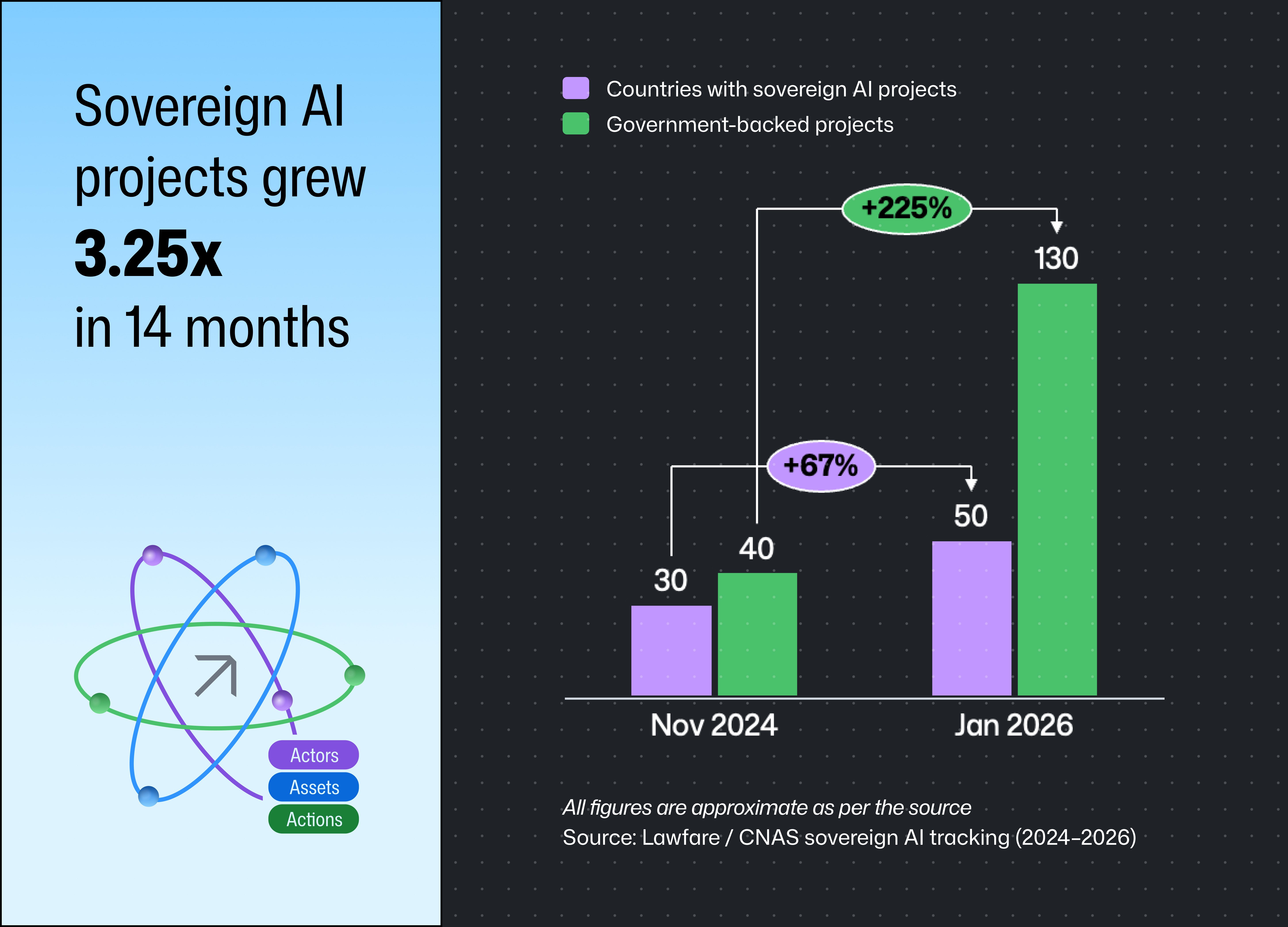
The velocity shows up everywhere. NVIDIA and Palantir this week announced a turnkey sovereign AI data center architecture for governments.² McKinsey estimates the sovereign AI market at $500–600 billion by 2030, with up to 40% of AI workloads moving to sovereign environments.³ Forrester predicts 2026 is the year governments adopt “tech nationalism” in AI procurement.⁶ The framing is converging across institutions — WEF and Bain at Davos,⁴ Deloitte’s 3,200-respondent enterprise survey⁵ — sovereign AI is no longer one theme among many. It’s being treated as a defining vector alongside agentic AI and physical AI.
And the national commitments are stacking up. South Korea selected five consortia to compete for sovereign AI champion status, backed by $381 million in government funding, with its AI Basic Act taking effect in January 2026.⁷ India launched a sovereign LLM at the AI Impact Summit under the IndiaAI Mission, a $1.25 billion national program.⁸ The EU is expanding its network of AI Factories through EuroHPC.⁹ Taiwan is building sovereign compute under its Southern Silicon Valley Initiative, targeting $48 billion in AI-related output by 2040.¹⁰ Saudi Arabia launched HUMAIN to build a full-stack AI ecosystem through its sovereign wealth fund.¹¹ And in the US, the White House has embraced “sovereign AI” as part of its international posture — positioning American technology as the foundation for other nations’ sovereign ambitions.¹
This is no longer a policy discussion. It’s an active buildout — real capital, real infrastructure, real geopolitical stakes. As I documented in our first Signals analysis of Q1 2026 convenings, the pattern across CES, Davos, the India AI Summit, and MWC Barcelona is consistent: the sovereign AI conversation has moved from policy to procurement.
The gap isn’t coverage. It’s structure.
There’s plenty of smart writing on sovereign AI. Lawfare mapped the US “sovereignty gap” in AI statecraft, identifying six recurring pressures driving nations to build.¹ The Atlantic Council outlined eight ways AI will reshape geopolitics in 2026.¹² Brookings asked whether AI sovereignty is even possible, proposing “managed interdependence” as the pragmatic alternative.¹³ McKinsey surveyed 300 executives and found 71% view sovereign AI as an “existential concern” or “strategic imperative.”³ The Linux Foundation published a global survey on the state of sovereign AI.¹⁴ Oxford Insights released its Government AI Readiness Index.¹⁵
Good work, all of it. But it’s episodic and siloed.
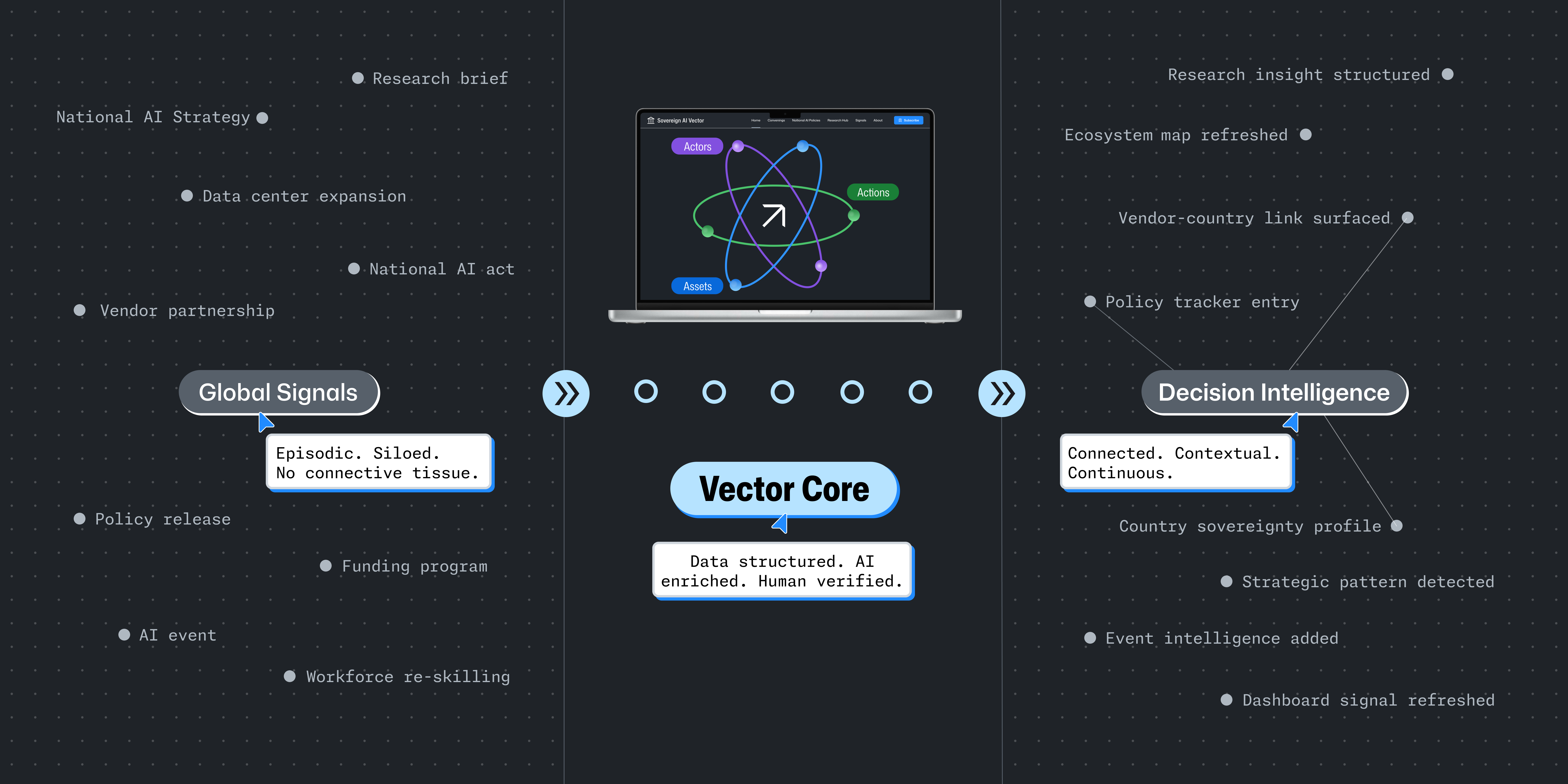
A Lawfare article covers statecraft. McKinsey sizes the market. A conference report covers one summit. A vendor announcement gets trade press. Nobody is connecting the dots across the actors driving sovereign AI, the assets being built, and the actions where decisions actually happen.
That’s the gap Sovereign AI Vector exists to close.
Chart 2: From fragmented coverage to unified intelligence with Sovereign AI Vector
What the data shows
Here’s one example. I’ve been tracking sovereign AI convenings — the summits, policy forums, and industry events where sovereign AI is being actively shaped. In 2026 alone, I’ve logged 188 across seven global regions.
Chart 3: Convenings/ Events by region
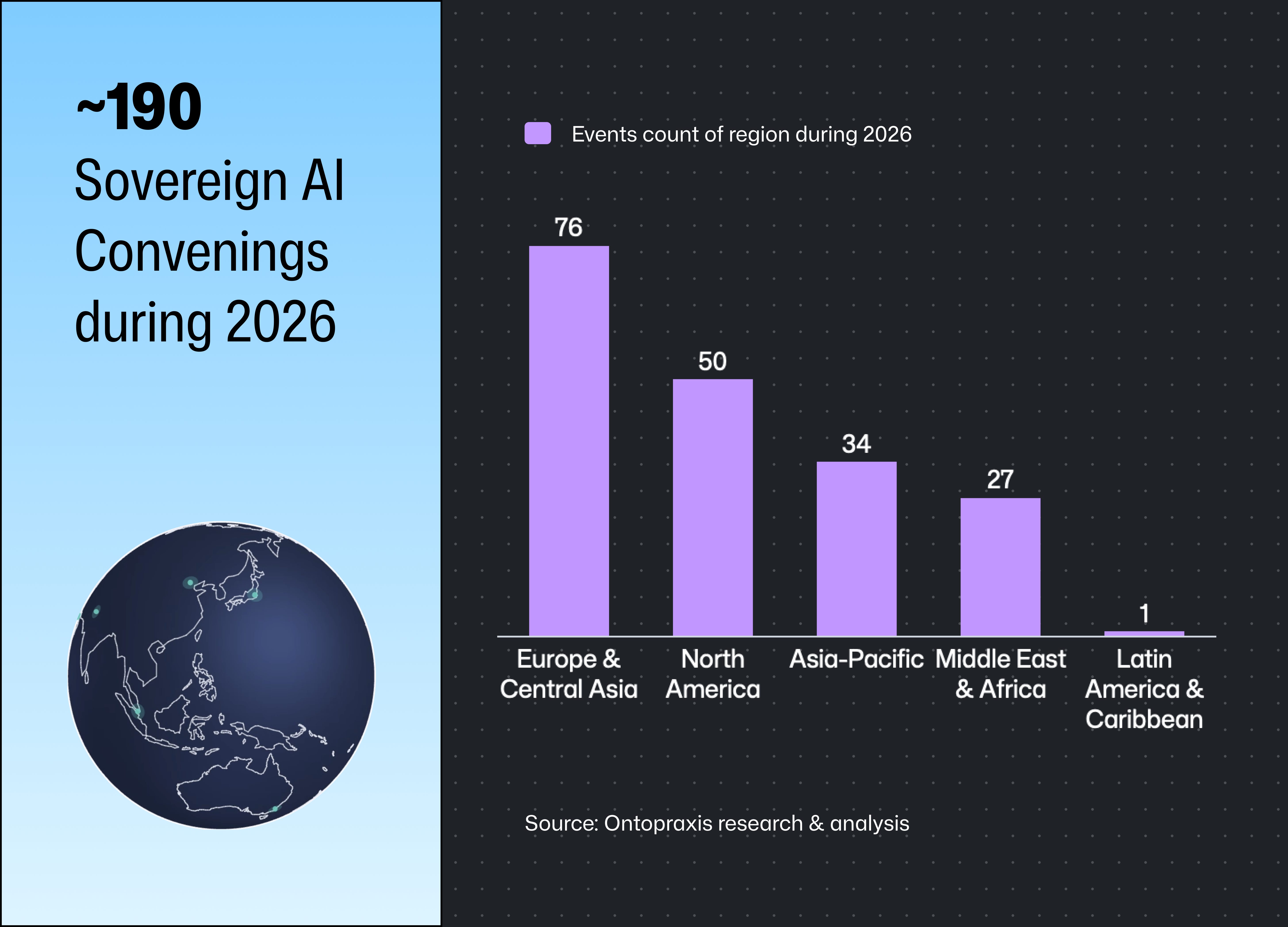
Europe dominates the calendar, but the distribution tells a broader story: sovereign AI convenings are happening on every continent, driven by distinct regional priorities — from EU digital sovereignty frameworks to Asia-Pacific compute buildouts to Middle East and Africa’s emerging national AI strategies.
These aren’t just conferences. They’re where policy gets announced, infrastructure partnerships get signed, and national AI strategies get pressure-tested in front of international audiences. And yet there’s no single resource that systematically tracks them.
What Sovereign AI Vector does
Sovereign AI Vector is an early-stage knowledge product that maps the actors, assets, and actions behind sovereign AI programs globally. It’s built for infrastructure and cloud vendors, policymakers, program teams, and researchers navigating sovereign AI strategy and execution.
The premise is simple: sovereign AI developments are fragmented across announcements, vendor news, policy forums, and events. I bring these signals into a structured, searchable view — so you can see what’s happening, where it’s happening, and why it matters.
Beyond convenings, I track how nations are building sovereign AI. National AI Policies maps strategies and policy frameworks across countries — the regulatory scaffolding that shapes where capital flows and how programs are structured. The Research Hub consolidates published research on sovereign AI from McKinsey, Brookings, the Linux Foundation, the Atlantic Council, and others — an area where output is accelerating but no single resource brings it together.
Sovereign AI Vector is the data product. This is the editorial layer — where I'll share analysis and patterns as this landscape evolves. If you work in AI policy, infrastructure, or enterprise strategy, both are built for you.
Disclaimer: This piece was written with AI assistance. All claims are sourced; cited references are listed below.
Sources
Tim Fist, “The Sovereignty Gap in U.S. AI Statecraft,” Lawfare, February 2026. lawfaremedia.org
“Palantir and NVIDIA Team to Deliver Sovereign AI Operating System Reference Architecture,” BusinessWire, March 12, 2026. businesswire.com
Ali Ustun et al., “The sovereign AI agenda: Moving from ambition to reality,” McKinsey, 2026. mckinsey.com; also “Sovereign AI: Building ecosystems for strategic resilience and impact,” McKinsey, March 2026. mckinsey.com
“Davos 2026: Smart thinking needed for sovereign AI investment,” Computer Weekly, January 2026. computerweekly.com
“How agentic, physical and sovereign AI are rewriting the rules of enterprise innovation,” World Economic Forum / Deloitte, January 2026. weforum.org
Sam Higgins, “Predictions 2026: Tech Nationalism Will Reshape Public-Sector AI, Security, and Procurement,” Forrester, October 2025. forrester.com
“LG, SKT, Naver among five selected for Korea’s sovereign AI push,” The Korea Herald, August 4, 2025. koreaherald.com; also “Can South Korea build a sovereign AI?” UPI, August 12, 2025. upi.com
“Sovereignty, safety, and scale: Takeaways from the India AI Impact Summit,” Brookings, March 2026. brookings.edu; also “Sarvam and the Sovereign AI Dream,” Inc42, February 2026. inc42.com
“Sovereign AI Is Becoming Public Infrastructure,” Swiss Institute of Artificial Intelligence, December 2025. siai.org
“Taiwan’s Sovereign AI Push: Strategy, Policy Programs and Implications for Businesses,” BowerGroupAsia, December 2025. bowergroupasia.com
“Government AI Readiness Index 2025,” Oxford Insights, January 2026. oxfordinsights.com
“Eight ways AI will shape geopolitics in 2026,” Atlantic Council, January 2026. atlanticcouncil.org
Cameron F. Kerry et al., “Is AI sovereignty possible? Balancing autonomy and interdependence,” Brookings, February 2026. brookings.edu
“The State of Sovereign AI,” The Linux Foundation, August 2025. linuxfoundation.org
“Government AI Readiness Index 2025,” Oxford Insights, January 2026. oxfordinsights.com
“Sovereign AI in 2025,” Natural Language Processing, Cambridge University Press, Volume 31, Issue 5, September 2025. cambridge.org
“NVIDIA CEO Jensen Huang and Global Technology Leaders to Showcase Age of AI at GTC 2026,” NVIDIA Newsroom, March 3, 2026. nvidianews.nvidia.com