

In our Q1 2026 analysis, we closed with a forward look: all eyes on San Jose, where GTC would lay out the compute roadmap underpinning national AI strategies. GTC has now delivered. What it revealed was not a pivot — it was an acceleration.
Four signals stand out.
🏭 Signal 1: Sovereign AI has become a material Go-to-Market category for NVIDIA
NVIDIA (NASDAQ: NVDA) explicitly highlighted sovereign AI as a distinct go-to-market category at GTC — alongside industrial AI and robotics, rather than treating it merely as an edge case of enterprise cloud. Jensen Huang noted that 40% of NVIDIA’s business now comes from outside the top five hyperscalers, encompassing industrial, robotics, and sovereign AI.1
NVIDIA Cloud Partners (NCPs) — its network of national and regional AI infrastructure operators — doubled their footprint year over year, cumulatively deploying more than one million GPUs in AI factories globally, representing over 1.7 gigawatts of AI capacity. That compares to 400,000 GPUs and 550 megawatts at last year’s GTC.2 Named countries: the United States, Australia, Germany, Indonesia, and India.
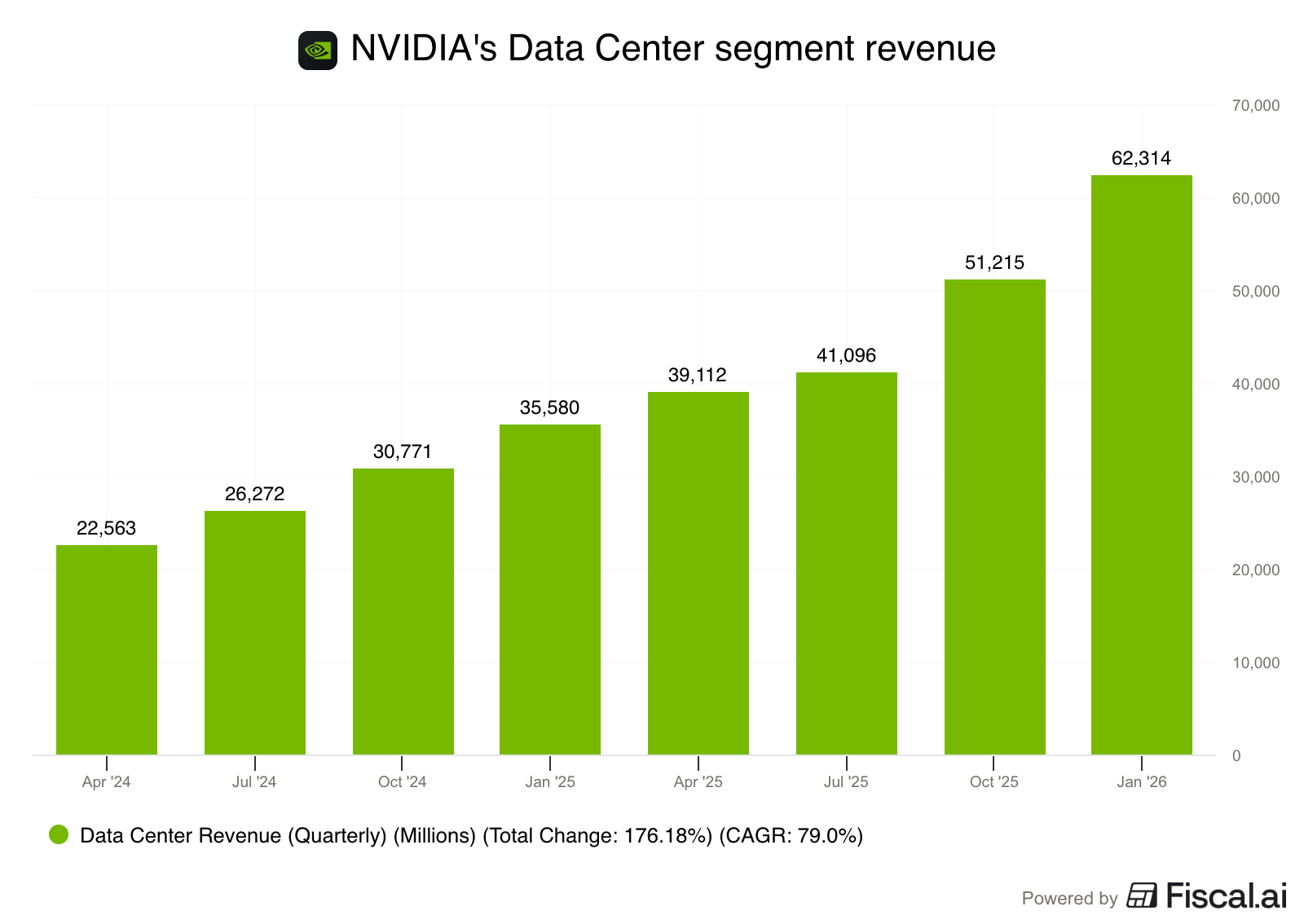
📊 By the numbers: NVIDIA's Data Center segment reached $62.3 billion in Q4 FY2026, up 75% year over year. For FY2026, NVIDIA disclosed its sovereign AI business more than tripled to over $30 billion. (Source: fiscal.ai / NVIDIA SEC filings)
The signal: sovereign AI has moved from aspirational rhetoric to material commercial relevance — large enough to be explicitly disclosed and emphasized at the highest level of NVIDIA's public narrative.
🏗️ Signal 2: The AI Factory is emerging as a core procurement model for National AI infrastructure
The conversation has moved from GPUs to AI factories — integrated, full-stack systems designed to produce AI at a national scale. Three announcements at GTC gave this concrete shape.
HPE (NYSE: HPE) will build AI factories at Argonne National Laboratory (US) and the High-Performance Computing Center Stuttgart (HLRS) in Germany. The HLRS deployment — HammerHAI — is the EU’s designated AI Factory under the EuroHPC Joint Undertaking, backed by public funding through EuroHPC and German federal and state partners. It will deliver more than 15 exaflops of peak inference performance on NVIDIA GB200 NVL4 architecture — designed, per HLRS Director Dr. Bastian Koller, to give European organizations access to AI resources without dependence on commercial cloud providers where data sovereignty has historically been difficult to ensure.3
Dell Technologies (NYSE: DELL) marked the two-year anniversary of its Dell AI Factory with NVIDIA by announcing a major expansion — including a new Data Orchestration Engine, a flagship rack-scale system on NVIDIA Vera Rubin NVL72, and an explicit on-premises positioning. Dell noted that CIOs are increasingly choosing to develop AI in-house, driven by data sovereignty, security, and total cost of ownership. Over 4,000 enterprise customers have deployed the Dell AI Factory to date.4
DDN and Aleria announced a Sovereign AI Factory on NVIDIA Vera Rubin DSX architecture — a single-SKU, fully auditable offering for governments and regulated enterprises. Ten sovereign deployments are planned within 24 months across the UAE, Oman, Indonesia, Portugal, the US, Brazil, and Europe.5
Microsoft (NASDAQ: MSFT) Azure extended its sovereign posture by expanding Azure Local — its on-premises offering for regulated industries — to support NVIDIA RTX PRO 6000 Blackwell GPUs, with Rubin platform support planned for later in 2026.2
The signal: the AI factory is emerging as a core procurement model for national AI infrastructure — not a chip order or a cloud contract, but a full-stack system with sovereignty built into the architecture.
🤖 Signal 3: The Agentic layer extends the sovereignty surface
The keynote’s most extended section covered agentic AI — autonomous systems that plan and execute tasks continuously. Jensen Huang’s framing: every company in the world needs an agentic systems strategy.1
For sovereign AI, this matters in a specific way. For many sovereign and regulated use cases, always-on agents processing sensitive national data will be difficult to justify on a generic public cloud alone. They will often require customer-controlled or regionally governed environments. The sovereignty argument now extends beyond where data sits, or models are trained, to where agents run and who governs their actions.
Two announcements gave this concrete shape. IBM (NYSE: IBM) and NVIDIA said they are exploring integrating IBM Sovereign Core with NVIDIA infrastructure and Nemotron models to enable GPU-intensive workloads to run within regional boundaries while preserving governance and compliance.6 Palantir (NYSE: PLTR) announced a full-stack sovereign AI operating system reference architecture on NVIDIA infrastructure — a turnkey AI datacenter from hardware procurement to application deployment, purpose-built for data sovereignty and regulated environments.7
The signal: the sovereignty perimeter is expanding. Data residency was the first frontier; model governance the second. Agentic infrastructure is the third.
🌐 Signal 4: Open models as an enabler of sovereign infrastructure
The Nemotron Coalition — announced on day one of GTC — positions open model development as an enabler of sovereignty. NVIDIA brought together eight AI labs: Black Forest Labs, Cursor, LangChain, Mistral AI, Perplexity, Reflection AI, Sarvam, and Thinking Machines Lab, to co-develop open frontier models on NVIDIA DGX Cloud, released as open-weight for any organization to fine-tune and deploy.8
The sovereign AI dimension runs deeper than the coalition itself. NVIDIA also disclosed that developers across nine organizations — including YTL (Malaysia), SOOFI (Germany), Viettel (Vietnam), and AI Singapore — are already using Nemotron models to build sovereign language models in their native languages, aligned to local cultures and values.9 Mistral (France) and Sarvam (India) bring the same logic to the coalition: customizable, open models that reduce dependence on US proprietary ecosystems.
A government or enterprise that depends entirely on proprietary external API ecosystems has limited sovereignty over its intelligence layer. Open models that can be fine-tuned domestically — on domestic data, within domestic infrastructure — close part of that gap. The Nemotron Coalition is the most organized expression of that argument to date.
The signal: open models are not just a technical preference — they are increasingly a component of sovereignty strategy.
🔁 The thread back to Q1
The Q1 analysis concluded: the sovereign AI conversation has moved from policy to procurement. GTC confirms what procurement now looks like — AI factories anchored to national institutions, enterprise on-premises deployments driven by sovereignty and TCO, agentic infrastructure designed for domestic governance, and open model coalitions giving nations a path toward sovereignty at the intelligence layer.
The question GTC leaves open is one of concentration. Sovereign AI infrastructure is, for now, almost entirely built on a single company’s architecture. Nations are asserting sovereignty over data, governance, and deployment — but the underlying compute stack flows through one roadmap. Whether that tension resolves through diversification, regulation, or deeper dependency is the signal worth watching next.
🎬 Sovereign AI Vector tracks national AI strategy across 50+ countries. This short film explains the idea behind our work. Explore the full product at sovereignaivector.com
About this analysis: We use a human-led, AI-assisted research and verification process. This analysis covers selected signals — not a comprehensive account of all developments. Cited sources are listed below for reference.