

In the last post, I argued that the gap in sovereign AI coverage isn’t volume — it’s structure. There’s plenty of writing on the topic. What’s missing is a consistent way to organize it.
That’s what this post is about.
The problem with tracking a moving landscape
Sovereign AI doesn’t announce itself cleanly. A ministry issues a strategy. A sovereign wealth fund backs an infrastructure deal. A national LLM ships. A bilateral agreement gets signed at a summit nobody covered.
Each of these is real. Each matters. But reported in isolation, they don’t add up to anything you can act on.
To make sense of a landscape this distributed, you need a unit of analysis. Not a theme. Not a region. A structured way of asking: who did what, with what, and when.
Our answer is a framework built around three entities — Actors, Assets, and Actions. Every development in the sovereign AI landscape is, at its core, one of these three things — an actor with agency, an asset with strategic value, or an action that shifts posture. Structured, comparable, and defensible across the countries we cover.
🏛️ Actors — the who
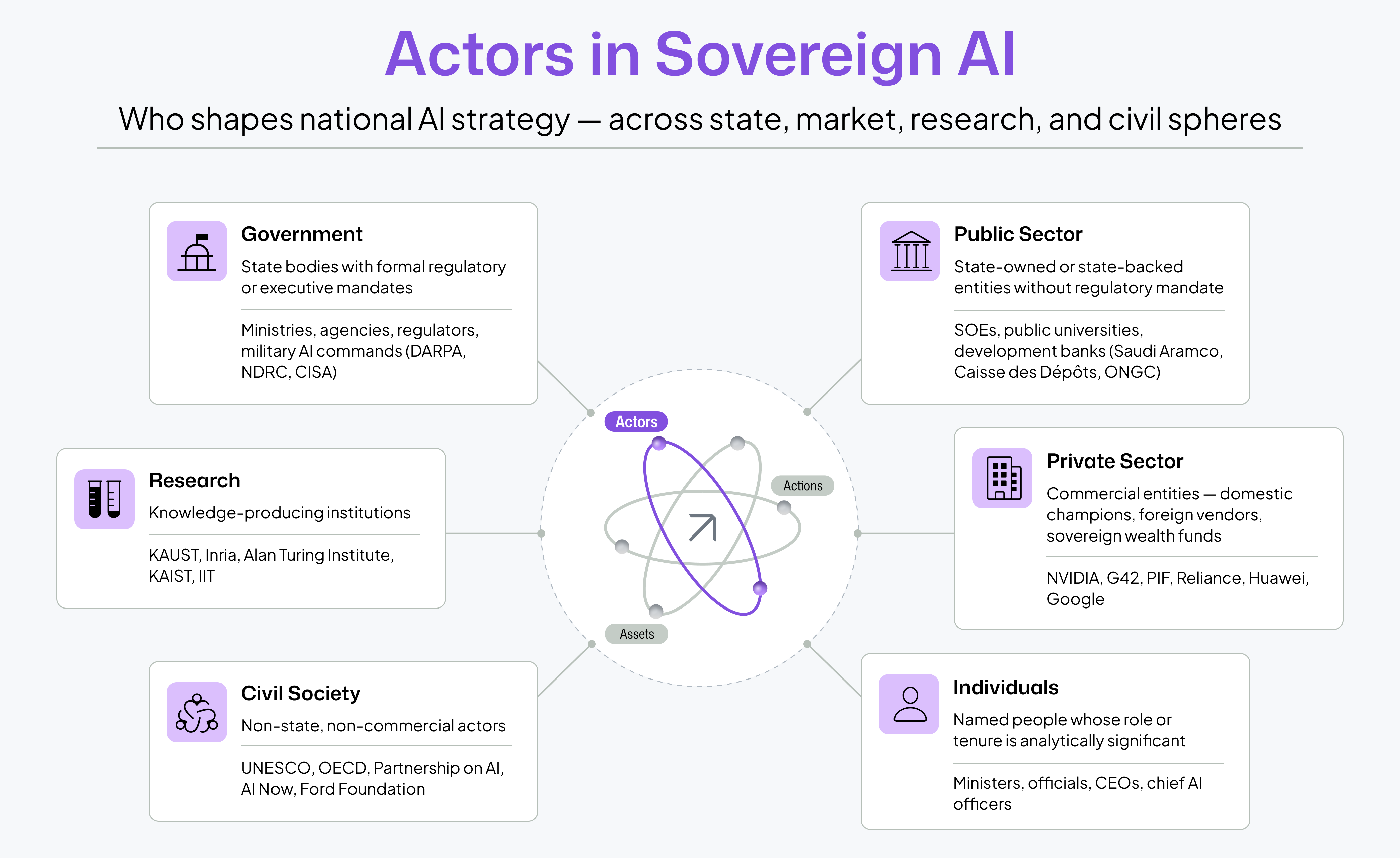
Sovereign AI isn’t shaped solely by governments. Sovereign AI Vector maps six categories of actors whose decisions determine how nations build, control, and deploy AI capability.
🏛️ Government — Sets the rules, allocates the budgets, and defines the strategic intent. The originating force behind every national AI program.
🏗️ Public Sector — Translates government intent into funded execution. Often, the entities that actually build what ministries announce.
🏢 Private Sector — Supplies the stack — compute, models, applications, and services. Their technology choices shape which infrastructure a country becomes dependent on.
🔬 Research — Generates the knowledge base that policy draws from and industry builds on. Where capability is validated before it scales.
🌐 Civil Society — Sets the normative boundaries. Multilateral bodies, ethics organizations, and foundations that determine what sovereign AI is allowed to look like.
👤 Individuals — The decision nodes. Sovereign AI posture often traces back to a small number of people with the mandate, budget, and authority to act.
🗄️ Assets — the what
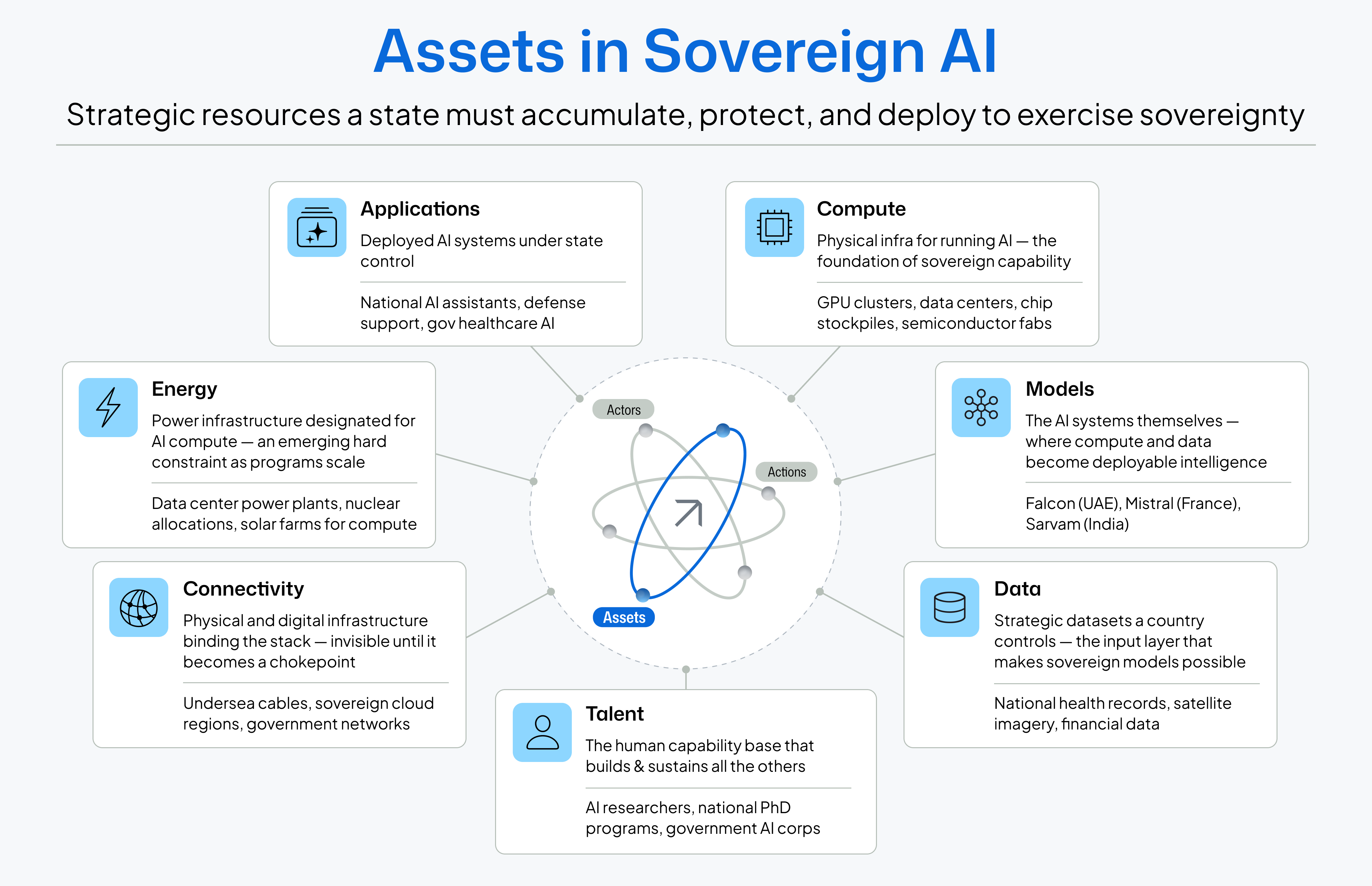
Announcing an AI strategy is not the same as having an AI capability. Assets are the physical and digital infrastructure that make sovereignty real — things that exist, persist, and can be built, acquired, controlled, or lost. Sovereign AI Vector tracks seven asset types across the countries it covers.
⚡ Compute — The foundation everything else runs on. Without sovereign compute, every other asset in this stack depends on someone else’s infrastructure decisions.
🤖 Models — Where data and compute combine into deployable intelligence. The difference between a country that uses AI and one that controls it.
🗃️ Data — The input layer — and often the first battleground. Sovereign data is what enables sovereign models.
👥 Talent — The only asset that builds and sustains all the others. Without it, compute sits idle and models go unmaintained.
🔗 Connectivity — Invisible until it fails. The infrastructure binding the stack — and a chokepoint that foreign actors can influence.
⚙️ Energy — An emerging hard constraint. As computing scales, power availability is becoming a primary limit on how far a sovereign AI program can go.
📱 Applications — The proof point. Where years of investment in infrastructure, models, and data become operational capability in the state's hands.
⚡ Actions — the what happened
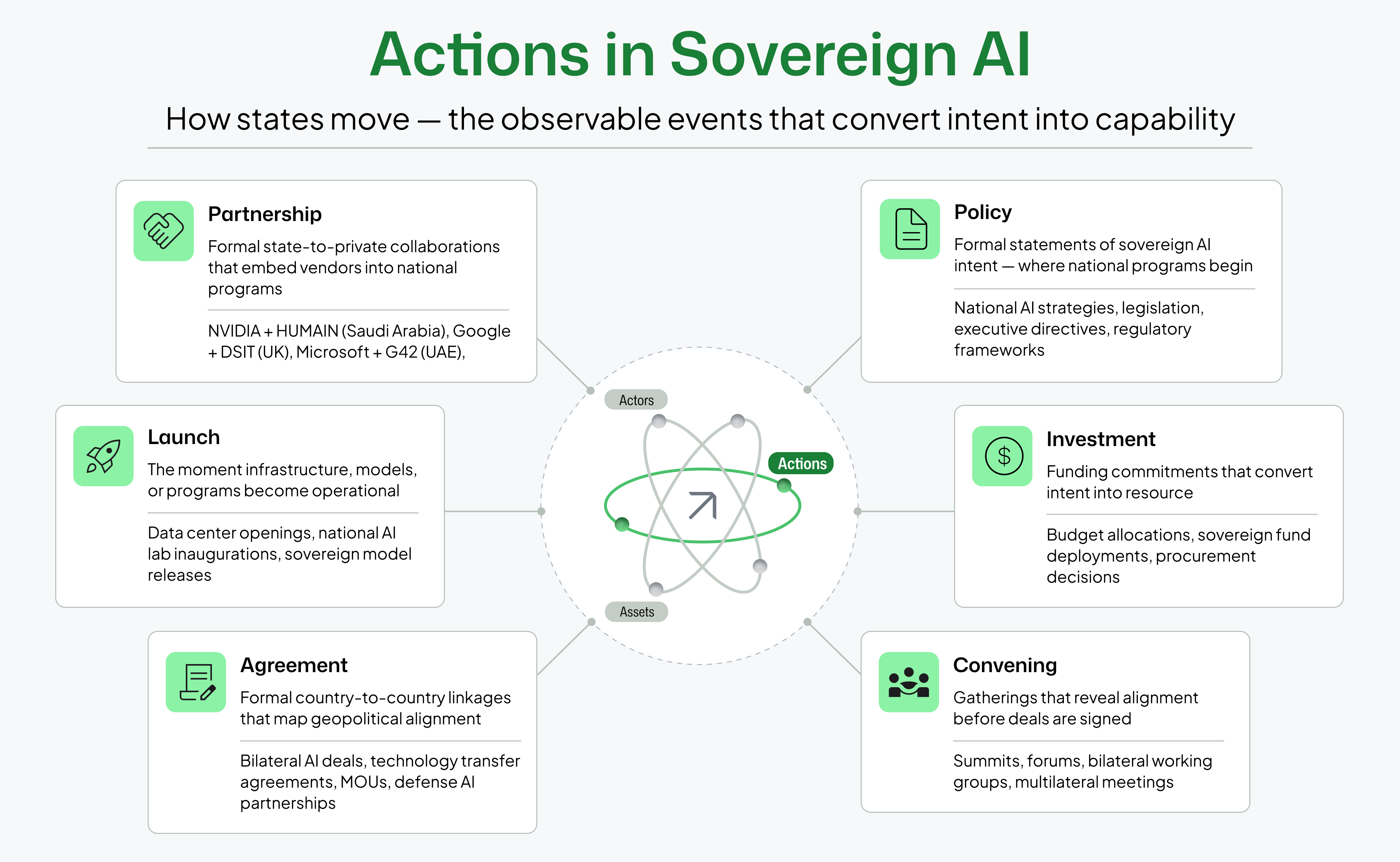
Actions are what change a country’s position. Every shift in sovereign AI posture — a budget commitment, a data center opening, a bilateral deal — traces back to a discrete action by a specific actor at a specific point in time.
📋 Policy — Where every sovereign AI program begins. But intent without investment or infrastructure is a signal, not a verdict.
💰 Investment — The commitment that separates announced programs from funded ones. We track not just what was pledged — but what has actually moved.
🤝 Convening — Where alignment becomes visible before it becomes official. Who shows up and who sits together tells you where the deals are heading.
🌍 Agreement — The formal architecture of who is building with whom. Bilateral deals and MOUs map the geopolitical structure of sovereign AI.
🏭 Partnership — Where state mandate meets private capability. The clearest signal of which vendors are embedding themselves into national programs — and how deep.
🚀 Launch — The hardest thing to fake. When a data center opens or a sovereign model ships, intent becomes operational fact.
Where this is going
The framework is the design behind Sovereign AI Vector — how it’s built to think, not just what it currently shows. The full implementation across 50+ countries is ongoing. National AI Posture profiles, the Intelligence Feed, and the Research Hub are the surfaces where the framework becomes visible publicly.
This post is the architecture behind those surfaces.
If you work in AI infrastructure, policy, or enterprise strategy — and you’re trying to make sense of a landscape that’s moving faster than the coverage of it — Sovereign AI Vector is built for you.
Disclaimer: This piece was written with AI assistance.